Why Chasing Protein Alone Keeps You Hungry: The Fiber Partnership Your Bowl Is Missing
You built the bowl. Grilled chicken, Greek yogurt dressing, maybe a sprinkle of hemp seeds. You hit your protein target, checked the macro app, and felt genuinely proud of yourself. Then, about 75 minutes later, your stomach had opinions.
Sound familiar? You're not alone — and you're not doing it wrong, exactly. But there's a good chance your bowl is running on one engine when it needs two.
Protein gets all the spotlight in fitness nutrition circles, and for good reason. It supports muscle repair, keeps metabolic rate humming, and yes, it does contribute to fullness. But satiety — the real, sustained kind that carries you from lunch to your afternoon workout without a pit stop at the vending machine — is a two-player game. And fiber is the teammate most performance-focused eaters keep benching.
What Fiber Actually Does When You Eat It
Let's get into the mechanics, because this stuff is genuinely interesting.
When you eat soluble fiber — the kind found in oats, beans, lentils, and certain fruits — it absorbs water and forms a gel-like substance in your digestive tract. That gel slows everything down. Gastric emptying takes longer, glucose enters the bloodstream more gradually, and your hunger hormones get a much more stable signal.
Insoluble fiber, on the other hand, adds bulk and keeps things moving. It also stimulates stretch receptors in your stomach, which send fullness signals to your brain faster than a lot of people realize.
Protein works through a different pathway. It suppresses ghrelin (your main hunger hormone) and stimulates peptide YY and GLP-1, both of which tell your brain you're satisfied. The problem is that protein's satiety effect, while real, can fade relatively quickly when it's not paired with something that physically slows the digestive process.
That's where fiber steps in. Together, they create a longer, more stable window of fullness than either one can manage solo.
The Ratio Worth Knowing
Here's where it gets practical. Research suggests that meals hitting roughly 25–30 grams of protein alongside 8–12 grams of fiber tend to produce the most sustained satiety responses — especially for active adults whose caloric needs are higher and whose hunger signals can swing more dramatically around training.
Most fitness-focused eaters are clearing the protein bar without breaking a sweat. The fiber side? The average American gets around 15 grams of fiber per day total, against a recommended target of 25–38 grams. That means a single bowl ideally contributes somewhere in the 8–12 gram range just to keep pace — and a lot of popular high-protein bowls fall well short of that.
A grilled chicken breast over white rice with a drizzle of sauce might clock 35 grams of protein. But if fiber sits at 2–3 grams? Your stomach processes that meal quickly, hunger hormones rebound, and suddenly your "perfect macro bowl" has a 90-minute expiration date on satisfaction.
Building a Bowl That Actually Works Both Angles
Good news: hitting the fiber-protein sweet spot doesn't require a nutrition degree or a complicated meal plan. It mostly requires knowing which ingredients pull double duty — and being intentional about base choices.
Base matters more than you think. Swapping white rice for a farro-lentil blend or a mix of brown rice and quinoa can add 5–7 grams of fiber before you've touched a single topping. Cauliflower rice mixed with a legume base is another solid move if you're watching carbs overall.
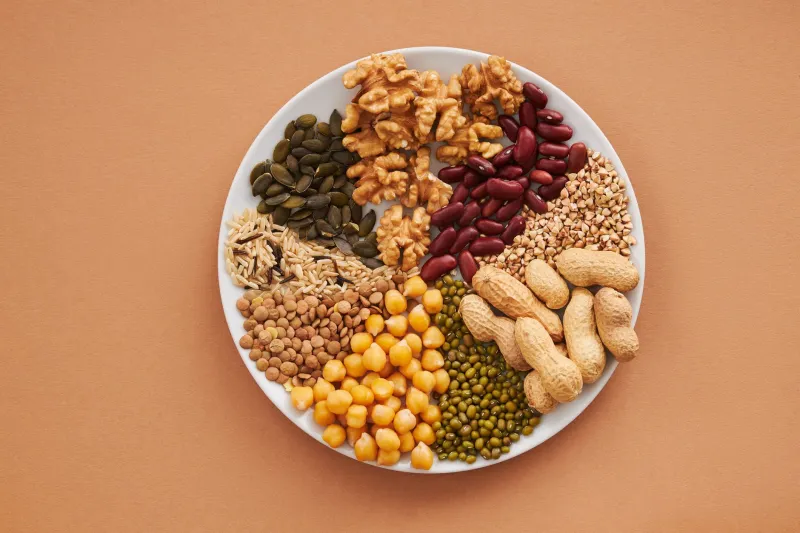
Legumes are your best friends. Black beans, chickpeas, edamame, and lentils all bring serious fiber alongside meaningful protein. A half-cup of black beans adds roughly 7–8 grams of fiber and 7 grams of protein. Stacking those on top of a chicken or salmon base means you're building from both directions at once.
Don't sleep on vegetables with actual fiber content. Not all vegetables are equal here. Broccoli, Brussels sprouts, artichoke hearts, and roasted sweet potato all contribute meaningfully to your fiber count. A cup of roasted broccoli, for instance, brings about 5 grams. Compare that to iceberg lettuce, which barely registers, and the base salad choice suddenly matters a lot.
Seeds and nuts add up fast. A tablespoon of chia seeds brings nearly 4 grams of fiber. Flaxseed, hemp seeds, and almonds all contribute. These are easy to layer in without dramatically changing your bowl's flavor profile.
A Few Real Bowl Combos That Hit the Sweet Spot
Want to see what this looks like on an actual plate? Here are three combos that land in that 25–30g protein / 8–12g fiber zone without requiring a spreadsheet:
The Southwest Power Bowl: Farro base, grilled chicken, black beans, roasted corn, sliced avocado, pico de gallo, and a lime-cumin yogurt drizzle. Roughly 34g protein, 11g fiber. Satisfying for hours, genuinely delicious.
The Mediterranean Builder: Quinoa and lentil base, baked salmon, roasted red pepper, cucumber, artichoke hearts, olives, and a tahini-lemon dressing. Around 32g protein, 10g fiber. Works great as a post-workout recovery meal.
The Plant-Forward Option: Brown rice base, crispy baked tofu, shelled edamame, shredded purple cabbage, matchstick carrots, sliced snap peas, and a ginger-miso dressing. Approximately 28g protein, 12g fiber. Fully plant-based and genuinely filling.
Notice what all three have in common: a protein anchor, a fiber-rich base, and at least one legume or high-fiber vegetable doing extra work in the middle.
The Hunger Signal Delay Is Real — And It's Not Just Psychological
One thing worth calling out: if you eat a high-protein, low-fiber bowl and feel hungry an hour later, that's not a willpower problem. That's physiology. Your body processed the meal efficiently, gastric emptying moved along on schedule, and hunger hormones came back online. You did everything "right" by the protein-obsessed playbook and still ended up hungry. That's the system working as designed — it's just an incomplete system.
Adding fiber doesn't mean eating more food. Often it means swapping one ingredient for another — white rice for a grain-legume blend, a plain chicken breast for a bowl that incorporates beans alongside the protein. The calorie difference is often minimal. The satiety difference can be significant.
The Bottom Line for Your Bowl Strategy
Protein is essential. Nobody here is arguing otherwise. But if your performance nutrition strategy is all protein, all the time, you're leaving a major lever unpulled. Fiber is the co-pilot that keeps your fullness signal flying at altitude instead of dropping off a cliff 90 minutes after lunch.
Next time you're building your bowl, ask two questions instead of one: Did I hit my protein? And: Did I get enough fiber to make this actually last?
Both answers need to be yes for the bowl to really work. That's the ratio nobody's putting on their macro tracker — and it might be the most practical change you make to your eating this week.