Your Healthy Bowl Tastes Like Nothing — Here's the Flavor Science That Actually Fixes It
The Beige Bowl Is Real and It's Everywhere
You know the one. Brown rice, plain grilled chicken, steamed broccoli, maybe a wedge of lemon you squeeze halfheartedly over the top. It's nutritionally sound. It checks every box. And it tastes like commitment — admirable, joyless, and slightly punishing.
This is one of the most common friction points for people trying to eat well consistently: the healthy bowl becomes a chore. And when eating feels like a chore, consistency collapses. You don't fall off your nutrition plan because you lack discipline. You fall off because nobody can sustain eating food that doesn't taste good.
Here's the thing: bland healthy bowls aren't a cooking talent problem. They're a flavor strategy problem. And flavor strategy is learnable.
Why Healthy Ingredients Often Taste Flat
Before getting into the fixes, it helps to understand why this happens in the first place.
Many of the ingredients that are best for you — lean proteins, whole grains, cruciferous vegetables — are inherently low in the compounds that make food taste exciting. They're low in fat (which carries flavor), low in sugar (which triggers pleasure responses), and low in the volatile aromatic compounds that make food smell irresistible before it even hits your tongue.
Conventional cooking compensates for this with salt, butter, cream, and sugar — all of which work brilliantly but come with caloric and nutritional trade-offs. The challenge is finding ways to create the same sensory experience without those shortcuts.
The solution isn't to add more of what you're already using. It's to activate different flavor mechanisms entirely.
Shift One: Add Something Fermented
Fermented ingredients are the single most underused tool in the healthy bowl arsenal. And they do something that no amount of seasoning salt can replicate: they add depth.
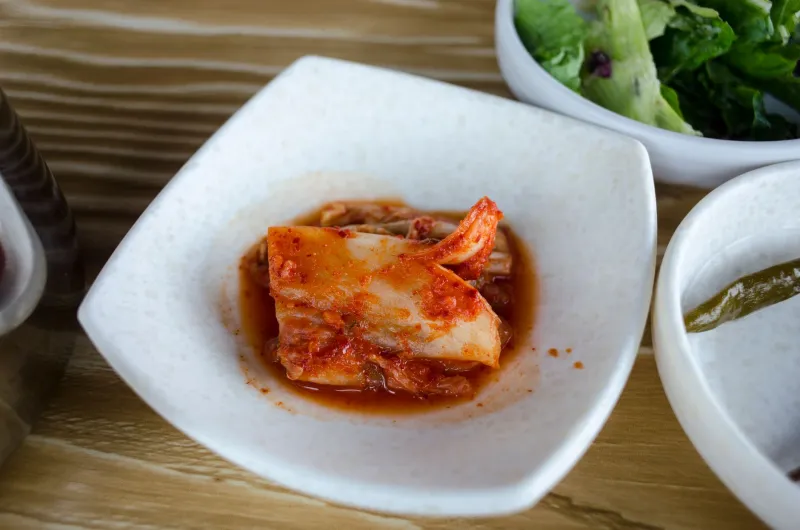
Fermentation produces glutamates — the naturally occurring compounds responsible for umami, that savory, mouth-coating quality that makes food feel satisfying in a way that's hard to articulate. Miso, kimchi, sauerkraut, plain yogurt, and even a splash of good apple cider vinegar all introduce fermented complexity that makes surrounding ingredients taste more like themselves, only better.
A tablespoon of white miso whisked into a dressing does more flavor work than a heavy hand of soy sauce. A spoonful of kimchi tucked into a grain bowl adds heat, acid, and funk that transforms the whole thing. A dollop of plain Greek yogurt as a sauce base brings tang and creaminess with a fraction of the caloric cost of tahini or aioli.
Beyond flavor, fermented additions bring probiotic benefits and, in the case of miso and fermented vegetables, a range of bioactive compounds that support gut health. This is a fix that earns its place nutritionally, not just culinarily.
Shift Two: Build Aroma Before You Build the Bowl
Flavor is roughly 80% smell. This is not a metaphor — it's olfactory science. The volatile aromatic compounds in food reach your olfactory receptors before anything touches your tongue, and they account for the vast majority of what you actually perceive as flavor.
Most healthy bowl builders skip the aroma step. They roast vegetables, cook their grain, assemble their protein, and call it done. But a few minutes of deliberate aromatic work at the start of cooking changes the entire experience.
Toast whole spices — cumin seeds, coriander, mustard seeds — in a dry pan before grinding or adding them to your dish. The heat releases volatile oils that are largely absent in pre-ground spices. Bloom dried spices in a small amount of oil before they touch anything else. Let your garlic and ginger cook long enough to develop sweetness rather than adding them raw at the end. Char the cut side of a lemon before squeezing it over your finished bowl — the brief caramelization of the sugars in the peel produces aromatic compounds that make the juice taste completely different.
None of this adds meaningful calories. All of it adds meaningful flavor.
Shift Three: Make Texture Do Some of the Work
One of the reasons bland bowls feel so unrewarding is that they're texturally monotonous. Soft grain, soft protein, soft vegetables — everything yields at the same rate, which means your brain processes each bite as essentially the same experience. Monotony in texture accelerates what food scientists call sensory-specific satiety, where your enjoyment of a food drops rapidly as you continue eating it.
Contrast fixes this. When a bowl contains something crispy alongside something creamy alongside something chewy, each component stays interesting longer because the eating experience keeps varying. Your brain doesn't habituate as quickly, which means you stay engaged with the food and — critically — you feel more satisfied when you're done.
Practical texture contrasts that add almost no calories:
- A small handful of puffed quinoa or toasted buckwheat groats sprinkled over a smooth bowl
- A few torn pieces of nori or a crumbled rice cake for a paper-thin crunch
- Thinly shaved raw vegetables (radish, fennel, cucumber) over cooked components
- A spoonful of something pickled — quick-pickled onions take five minutes and keep for two weeks in your fridge
The pickled element also does double duty by introducing acidity, which is the other major flavor driver that most healthy bowls are missing. Acid brightens every other flavor in the bowl, making ingredients taste more vivid without adding any fat or sugar.
The Satiety Connection
This isn't just about making food more pleasant, though that alone would be reason enough. Flavor complexity actually affects satiety signaling.
Research on sensory-specific satiety shows that more complex flavor experiences — those with multiple distinct tastes, aromas, and textures — produce stronger and longer-lasting satiety signals than simple, monotonous ones. A bowl that engages your full sensory system communicates "meal" to your brain more effectively than one that tastes like nothing.
Which means that fixing your flavor strategy isn't separate from your nutrition strategy. It is your nutrition strategy — because a bowl you actually want to eat is the only bowl that will ever consistently work for you.
Start Here
You don't need to overhaul everything at once. Pick one shift this week. Add a tablespoon of miso to your next dressing. Toast your spices before you use them. Throw together a quick-pickled red onion on Sunday and use it all week.
The beige bowl is fixable. And fixing it might be the most impactful thing you do for your long-term consistency.